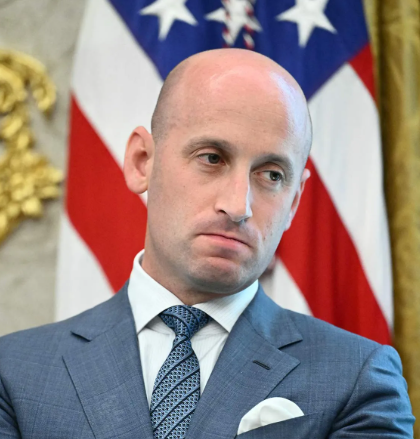
Biography
Background & current role
White House Deputy Chief of Staff for Policy and Homeland Security Advisor. This profile focuses on documented policy advocacy, public statements and claims concerning immigration, domestic policy, public health and executive-branch actions.
Current role: White House Deputy Chief of Staff for Policy and Homeland Security Advisor in the Trump administration.
This page is being populated newest-first as a high-volume Claims & Evidence archive. Factual assertions are separated from political rhetoric, and medical claims are checked against current primary health guidance and relevant independent reporting.
Role history & transitions
Documented current/future role notes
- Current role: White House Deputy Chief of Staff for Policy and Homeland Security Advisor in the Trump administration.
- TrumpsMouth separates Miller’s factual assertions from political rhetoric and evaluates checkable claims against primary records and independent evidence.
Claims & evidence
Evidence tracker
August 10, 2026 · Childhood vaccines & coadministration
Claim that giving several childhood vaccines at one visit is a “medical travesty” with serious immune or neurological consequences
NOT SUPPORTED — evidence does not show that routine vaccine coadministration causes the broad immune or neurological harms suggested
 92% evidence gapWELL SUPPORTED
NOT SUPPORTEDWhat is being said
During the August 10 Oval Office vaccine-policy event, Miller described the existing childhood schedule as a “medical travesty” and said parents are pressured to give babies five, six or seven shots at once. He tied same-visit vaccination to prolonged high fevers, disrupted eating and sleep, and broader immunological or neurological concerns.
What the record shows
It is true that children can receive multiple vaccines during one visit, although combination products often reduce the number of injections. Current CDC vaccine-safety guidance says getting several vaccines at the same time has been shown to be safe and does not cause chronic health problems. CDC notes that some combinations can modestly increase short-term fever or febrile-seizure risk, but those effects are temporary and do not establish the broad immune or neurological harm Miller suggested. The American Academy of Pediatrics likewise states that simultaneous administration of most recommended vaccines is safe and effective and that children have sufficient immunologic capacity to respond to multiple vaccine antigens.
Response / rebuttal
The administration argues that more spacing and parental choice could reduce perceived burden and increase confidence. Parents can discuss timing and specific contraindications with clinicians, and some vaccine combinations have known short-term side-effect differences. Those points do not establish that the standard practice of giving multiple recommended vaccines at one visit is generally medically dangerous.
Limits / uncertainty: The number of injections at any particular visit depends on age, prior doses, vaccine availability and use of combination products. This review rates the broad safety implication, not subjective claims about whether parents feel pressured or whether the schedule is too burdensome.
January 24, 2026 · Immigration enforcement & use of force
Alex Pretti was a “would-be assassin” who tried to murder federal agents
NOT SUPPORTED — the available video and public investigative record did not substantiate the “would-be assassin” / attempted-murder characterization
96% evidence gapWELL SUPPORTED
NOT SUPPORTED What is being said
Within hours of federal agents fatally shooting Alex Pretti in Minneapolis, White House Deputy Chief of Staff Stephen Miller posted that a “would-be assassin” had tried to murder federal law enforcement and grouped him with “terrorists.”
What the record shows
Publicly available video reviewed by Reuters showed Pretti holding a cellphone rather than a gun as agents wrestled him to the ground. Reuters reported that his holstered handgun was removed by an officer shortly before the first shots were fired, and that he had a lawful permit to carry it. Minnesota’s Bureau of Criminal Apprehension later confirmed that its independent investigation was collecting witness statements, physical evidence and video evidence, while noting that the investigation remained ongoing. No public evidence identified in the reviewed record supported the specific assertion that Pretti attempted to murder federal agents.
Response / rebuttal
The administration initially emphasized that Pretti was armed and that officers faced a rapidly evolving confrontation. Days later, Miller said officials were evaluating why the CBP team may not have followed White House protocol, and President Trump publicly declined to endorse the assassin characterization.
Limits / uncertainty: The state and federal investigations were still unresolved when these statements were made. Video evidence can establish visible actions but cannot by itself resolve every question about intent; this assessment is limited to whether the strong public claim of attempted murder was supported by evidence made public at the time.
May 28, 2025 · Immigration enforcement targets
ICE should aim for a minimum of 3,000 arrests per day
MIXED / NEEDS DISTINCTION — Miller accurately described a publicly announced goal, but the government later told the court it was not a formal ICE quota or directive
38% evidence gapWELL SUPPORTED
NOT SUPPORTED What is being said
In a Fox News interview, White House Deputy Chief of Staff Stephen Miller said the administration was looking to set a goal of at least 3,000 ICE arrests every day and that President Trump would keep pushing the number higher.
What the record shows
Miller did publicly announce the 3,000-per-day figure as an administration goal. But in the Los Angeles immigration-enforcement litigation Vasquez Perdomo v. Noem, the federal government later represented to the Ninth Circuit that DHS had confirmed neither ICE leadership nor field offices had been directed to meet a numerical quota or target, and that the 3,000 figure had not been set as formal policy or issued as a directive. The public record therefore supports that Miller announced an aspirational goal, while also showing that the government later denied a binding operational quota or directive existed at that time.
Response / rebuttal
The government’s 28(j) submission distinguished an administration goal from a mandatory agency quota, saying enforcement decisions were based on individualized assessments, resources and changing operational priorities. That distinction matters: a political or management goal can exist without a formal field-office quota.
Limits / uncertainty: The record reviewed here does not establish whether informal pressure, performance expectations or later internal directives were communicated outside a written quota policy. It assesses the narrower public discrepancy between Miller’s announced goal and the government’s later representation about formal ICE/DHS policy.
Directly related evidence records
These records are stored once in the canonical evidence archive and surfaced here because this person is directly involved in the underlying action, agency, statement or dispute.
July 17, 2026 · Immigration / Banking access / White House policy · Directly related record
Stephen Miller says Trump ordered banks to stop serving undocumented immigrants
OVERSTATED — THE ORDER DOES NOT CATEGORICALLY BAN BANK ACCOUNTS
78% evidence gapWELL SUPPORTED
NOT SUPPORTED Why it appears on this profile: Miller made the July 17 statement and described the administration’s intended use of banking restrictions as a self-deportation tool.
What is being said
During a July 17 interview on The Clay Travis and Buck Sexton Show, White House Deputy Chief of Staff Stephen Miller said Trump had signed an executive order “saying that we are not going to allow illegal aliens to use banking services in this country.” He added that shutting down access to credit cards, bank accounts and direct deposit would be “a massive engine for deportation.”
What the record shows
Executive Order 14406, signed May 19, directs Treasury and federal financial regulators to flag suspicious activity tied to unlawful employment, consider stronger customer-due-diligence rules, allow additional immigration-status information when relevant to fraud or other illicit-finance risks, and consider credit risks tied to loss of lawful work authorization. It does not order banks to close every account held by an undocumented person or categorically bar such people from ordinary deposit accounts. The CFPB’s current consumer guidance also states that a Social Security number is not required to obtain a bank or credit-union account, while existing credit rules permit creditors to consider immigration status in evaluating repayment risk. Treasury’s June 5 FinCEN advisory likewise focuses on suspicious activity and unlawful-employment schemes rather than a universal account ban.
Assessment context: Miller accurately described an administration effort to use financial regulation as part of immigration enforcement, but he overstated what the signed executive order itself says. The order creates a risk-based regulatory and enforcement framework; it does not enact the categorical nationwide banking-services prohibition his wording suggests.
Open canonical evidence record →
July 17, 2026 · Commercial driver licenses / Immigration / Transportation · Directly related record
Stephen Miller estimates one-third of all U.S. commercial driver licenses went to undocumented immigrants
NOT SUPPORTED — CONFUSES SELECTED AUDIT FAILURE RATES WITH THE NATIONAL CDL POPULATION
94% evidence gapWELL SUPPORTED
NOT SUPPORTED Why it appears on this profile: Miller made the one-third national CDL estimate during the July 17 interview.
What is being said
In the same July 17 interview, Miller said, “I think it’s probably a good estimate about a third of the nation’s CDLs, commercial driver’s licenses, have been issued to illegal aliens,” while describing a crackdown on commercial-driver-license fraud.
What the record shows
FMCSA’s own data show millions of CDL/CLP holders and distinguish ordinary state-domiciled CDLs from the much smaller non-domiciled category for certain foreign-domiciled drivers. DOT has reported substantial state-level problems: one-third of the Minnesota non-domiciled records it reviewed were improperly issued, nearly one-fifth of an Illinois sample was improper, and more than 28,000 illegally issued non-domiciled licenses had been revoked nationwide by spring 2026. Those findings establish real compliance failures, but they are not evidence that one-third of every CDL in the United States belongs to an undocumented immigrant. FMCSA’s 2026 final rule also makes clear that some non-domiciled CDLs are lawfully available to people in specified lawful employment-based nonimmigrant statuses, so “non-domiciled,” “foreign-born,” “non-citizen,” and “undocumented” are not interchangeable categories.
Assessment context: The administration has documented unlawful or noncompliant CDL issuance in multiple states, but Miller’s national one-third estimate is unsupported by the cited audits and conflates distinct populations. The closest matching official one-third figure concerns a sample of Minnesota’s non-domiciled CDLs, not the entire national CDL population.
Open canonical evidence record →
July 1, 2026 · Birthright citizenship / Immigration policy · Directly related record
Stephen Miller floats tighter pregnancy-based entry restrictions after birthright-citizenship ruling
CONTEXT NEEDED — birth tourism is already restricted in visitor-visa policy; a broader pregnancy-based entry ban would be a different policy
42% evidence gapWELL SUPPORTED
NOT SUPPORTED Why it appears on this profile: Miller made the public post-ruling policy argument and is the directly involved White House policy official in this record.
What is being said
In a July 1 Fox News appearance summarized and transcribed by RealClearPolitics, Miller said the Court’s ruling required the administration to think carefully about who is allowed to enter temporarily and invoked people coming to the United States “just to have babies on American soil” so the child becomes a citizen.
What the record shows
The Supreme Court’s June 30 decision in Trump v. Barbara held that children born in the United States to parents unlawfully or temporarily present are citizens at birth under the Fourteenth Amendment. Separately, State Department visitor-visa guidance already says “birth tourism” — travel whose primary purpose is giving birth in the United States to obtain citizenship for the child — is not a permissible basis for a visitor visa. Miller’s remarks therefore describe a possible broader restriction after the Court ruling, not the first federal policy addressing birth tourism.
Assessment context: The constitutional ruling is clear, and the government already screens visitor-visa applicants for birth-tourism purpose. A proposal to exclude pregnant travelers more broadly would go beyond that existing rule and would require its own legal and policy basis.
Open canonical evidence record →